
Reverend Stephen Johnson: Lyme's Radical Cleric
“The shot heard ‘round the world”, fired at Lexington in 1775, is typically how we mark the beginning of the American Revolution. But wars don’t arise out of thin air—especially wars undertaken against the most powerful imperial army in the world. Before war comes ideology, and few writers were more important in developing the rhetoric of revolution than Lyme’s own Reverend Stephen Johnson.
A decade before the Revolution, Reverend Johnson, the minister of Lyme’s First Congregational Church, wrote a series of pamphlets decrying Britain’s Stamp Act, and urged resistance. Johnson’s pamphlets were published in New London and New York in the autumn of 1765, and distributed all along the east coast of the American colonies, fueling an uprising that challenged the authority of the British Crown. The colonists’ resistance to the British Stamp Act introduced the ideological principles that would become the foundation of the American Revolution: inalienable rights, no taxation without representation, and self-governance.
Faced with debt resulting from the Seven Years’ War, the British Crown sought new sources of revenue to fill its depleted coffers. America became a prime target for these fundraising efforts, starting in September 1764 when Parliament imposed the Sugar Act on the colonies. This placed a tax on molasses and heavy tariffs on the direct import of wine and textiles, forcing these items to go through British ports first. Adding insult to injury, the Sugar Act also set up admiralty courts in Nova Scotia to try maritime cases, circumventing the authority of American courts. The Act was met with wide derision and resistance in the colonies, especially in Connecticut which had been accustomed to being generally autonomous in its governance. Britain was unable to effectively enforce the Sugar Act, which ultimately failed to provide the anticipated revenue.
The next attempt was more serious in intent, and much to Britain’s surprise, the source of more serious consequences. The Stamp Act, enacted by Parliament on March 22, 1765, would compel Americans to purchase tax stamps for all public documents and papers, including wills, deeds, contracts, licenses, newspapers, and even playing cards. The tax was substantial. Newspapers, for example, would have to pay a penny for each page and two shillings for each advertisement. Considering a yearly newspaper subscription cost between six and eight shillings, the Stamp Act would effectively put every newspaper in the colonies out of business.
Opposition was immediate. While the Stamp Act was passed in March, it wouldn’t go into effect until November, and Americans spent the spring and summer of 1765 organizing against it and petitioning for repeal. For their part, the British signaled their intent to enforce the act, and appointed Jared Ingersoll as Stamp Collector on June 5th.
!["The Repeal, or Funeral for Miss Ame[rica] Stamp. Political cartoon by satirist Benjamin Wilson (or after him). The Stamp Act being buried in the family vault along with King Charles I's notorious Star Chamber Court and Ship Money tax.](https://static.wixstatic.com/media/5f9a49_e321eba294f64071bd81db31520c3747~mv2.jpg/v1/fill/w_980,h_714,al_c,q_85,usm_0.66_1.00_0.01,enc_avif,quality_auto/5f9a49_e321eba294f64071bd81db31520c3747~mv2.jpg)
The people of Lyme responded by holding a mock trial of “J---d Stampman, Esq”, who was “indicted by the good People of this Colony” with the trial being held “before the Protectors of Liberty”. “Stampman” was symbolically charged with “being mov’d thereto by the instigation of the Devil, he did on the 29th of September 1764 kill and murder one of his own Brethren,” and further “he did, on the 5th day of June 1765, enter into a Confederacy with some other evil minded, wicked and malicious persons to kill and destroy his own Mother, Americana.” The two dates cited in the charges represent the passage of the Sugar Act and the appointment of Jared Ingersoll as Stamp Collector. In a chillingly pointed verdict, the “Stampman” was found guilty and sentenced to death by hanging from a “Gallows erected 50 feet high” with his body buried at “the meeting of three roads,” that location most likely being today’s Old Lyme town green at the intersection of McCurdy Road, Ferry Road, and Lyme Street, which would also be the site of Lyme’s Tea Party in 1774. This symbolic hanging
was set against the background of the very real confrontation the Sons of Liberty had when they promised Jared Ingersoll the stamp collector they would hang him if he didn’t resign. Ingersoll chose resignation over hanging.
An account of the mock trial appeared in the New London Gazette on September 6, 1765. The same issue also contained the first letter from Reverend Stephen Johnson opposing the Stamp Act. While the account of the mock trial was most probably also written by Johnson, we have confirmation from his close friend Reverend Ezra Stiles that the incendiary letters that appeared under the pen-names “Addison” and “Civis” in the Gazette that autumn were indeed Johnson’s work.
In his opening letter, Johnson tells his fellow Americans, “You have, my dear friends, as good a right to your Privileges as Britain have of theirs and you have as dearly bought them.” Standing on the traditions of the self-governing colony of Connecticut, and particularly Saybrook Colony which had been founded as a refuge for the Parliamentarian supporters of Cromwell a hundred and twenty years prior, Johnson instructs his readers: “Remember, O my friends, the Laws, the Rights, the generous Plan of Power deliver’d down, from Age to Age by your Forefathers, Ne’r ever let it Perish in your Hands, but piously transmit it to your Children.”

Johnson decries taxation without representation. While the British assure the Americans that they are “virtually”represented in Parliament, Johnson calls it “a mysterious representation, and of most uncertain Signification” which delegitimizes the British taxing authority:
If the British Parliament have right to impose a Stamp Tax, they have right to lay on us a Poll Tax, a Land tax, a Malt Tax, a Cyder Tax, a Window Tax, a Smoke Tax, and why not Tax us for the Light of the Sun, the Air we Breathe, and the Ground we are Buried in? If they have Right to deny us the Privilege of Tryals by Juries, they have as good a Right to deny us any Tryals at all, and to vote away our Estates and Lives at Pleasure”.
On October 11, Johnson draws an even sharper point and refers to the beheading of King Charles I at the hands of the Cromwellians in the English Civil War. Addressing the British threat to land 15,000 soldiers on American soil to quell the rebellion, Johnson writes:
But do not such sycophants know that a standing army for such purposes in a time of peace, is most contrary to the spirit of the British constitution? That it is most dangerous to the liberties of a free people, that Rome---France, and many others—lost their Liberties by it. Have they forgot how it alarmed our nation, and the effects of it in the reigns of Charles the first and James the second?
On November 1st, Johnson hammers it home, suggesting that pursuing the Stamp Act will not only break America from Britain, it may cause another civil war within Britain itself:
For if we may judge the experience of past ages, a free people will not continue under tyranny or military government any longer than ‘til they can reassume their rightful freedom. Such a measure would far more likely produce a distrust and hatred, terminating as hopeless, desperate, irreconcilable enmity, than any good consequence; Nor can the forcing act fail of producing great tumults and violences in England, as well as America, when their trade, their woolens and other manufactures fail for want of market.
Finally, Johnson directly threatens war:
If they must be absolute masters, and we wretched slaves, who may neither buy nor sell—nor have any legal securities or remedies, of defense of Life, Liberty, and Property, but upon their terms, to be newly fixed for us as oft as they see fit. Good God! Where is the constitution! What slender tenure this, for Englishmen to hold all their privileges by! As the result of all, Do not these measures tend to a very fatal Civil War?
As Stephen Johnson’s writings were reprinted in newspapers throughout the colonies, resistance to British rule stiffened, and on December 10, 1765, the Connecticut and New York Sons of Liberty met in New London where they agreed to come to the defense of any colony attacked by Britain if they chose to enforce the Stamp Act. Towns began issuing resolutions pledging to defy the Act and any attempts at enforcement. In what is also considered to be the work of Johnson, the town of Lyme issued its own Resolves in January 1766:
At a meeting of the respectable populace held at Lyme, in the County of New London, on the 2nd Tuesday of January 1766, the following Resolves were unanimously agreed to and to be inserted in the New London Gazette, vis.
That we have an inviolable right by the God of nature as well as by the English constitution (Which is unalienable even by ourselves) to the privileges and immunities which by the execution of the Stamp Act we shall be forever stript and deprived.
That we are unalterably fixt to defend our aforesaid Rights and Immunities, against every just attack by every lawful way and mean.
That our aversion and threats to any person in publick character or other in the colony, is and shall be only on account and according as they are more or less engaged, and active directly or indirectly, to carry into execution the detestable and oppressive Stamp Act which would be an indelible stain to England’s glory, and perpetual chains to American Liberty.
Inviolable and unalienable rights. No taxation without representation. Life, Liberty, and Property. American Liberty. Here, in the Lyme Resolves of 1766, we already see the language of revolution— a language that would be used ten years later to defeat an empire.
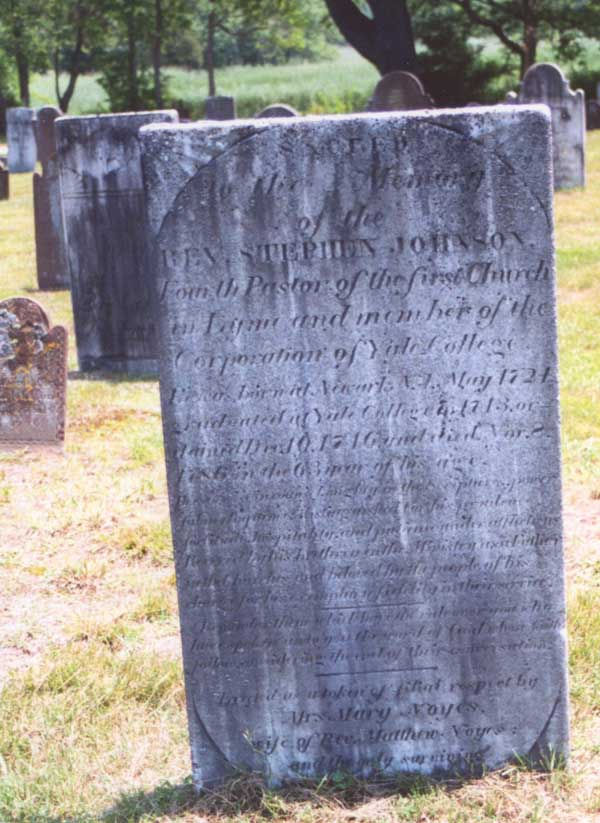
The Americans’ first taste of victory would come in March 18, 1766, when the British Parliament voted to repeal the Stamp Act. This was the first step in America gaining confidence that it could successfully repel British attempts to limit American autonomy. Thus began the steady march toward revolution in the decade to come.
Reverend Stephen Johnson pledged himself to the cause. In his November 1, 1765 letter he wrote: “My dear distressed country! For you I have wrote; for you I daily mourn, and to save your invaluable Rights and Freedom, I would willingly die.” This was not a hollow proclamation. Ten years later, Lyme’s 51-year-old Congregational minister marched with Samuel Holden Parsons’ Sixth Regiment to meet the British at Bunker Hill.


Comments