
George Washington's Visit Here in April 1776
Did George Washington spend the evening of April 10th 1776 dancing up a storm and impressing the ladies with his minuet and cotillion moves at Old Lyme’s Peck Tavern? Legend has it that he did. Had he spent that day examining America’s first submarine, the Turtle, being put through its paces at Poverty Island in the Connecticut River? Circumstances say it was both possible and likely. What we do know for certain is that General Washington graced our town with his presence 250 years ago, and the story of that day has lived on in the collective memory of our citizens ever since.

On March 17, 1776, in the early days of the Revolution, an unforeseen event occurred: the British abandoned Boston, never to set foot there again, leaving it forever in Patriot hands. After the long siege of that city flared into a pitched battle on the hills of Charlestown on June 19th 1775, and settled into stalemate through the following winter, everyone expected a renewed attack by the British when the ice melted that Spring. Instead, General Howe evacuated His Majesty’s troops from Boston without warning to the safe harbor of Halifax, and soon set his sights on New York City. Howe moved his men to Staten Island overlooking New York Harbor, and by summer 400 British ships arrived to join him in the effort to lock down that city for the Crown.
General George Washington, who had taken command of the Continental Army two days before the Battle of Bunker Hill, didn’t remain in Boston resting on his laurels. He broke camp in Cambridge and tailed the British to New York, where an even more consequential battle of the Revolution would ensue during the long, hot summer of ’76.
On his way from Cambridge to New York City, our Founding Father spent the evening of April 10, 1776 at the home of John McCurdy, a Son of Liberty who was purported to be the richest merchant in the state. McCurdy’s home, which hosted Washington and later Lafayette, still stands at 1 Lyme Street across from the South Green—a stately reminder of Old Lyme’s historical significance during the Revolution.

That Washington was in Old Lyme on April 10, 1776 is confirmed by Mount Vernon’s Washington Papers Archive, which lists McCurdy’s home as the general’s headquarters for that evening; and also by 19th century Yale historian Franklin B. Dexter, though Professor Dexter has Washington spending the evening of the 9th, not the 10th in Lyme.
Myths and legends have always followed in the trail of Washington's military career. The question of what occupied our founding father on the evening he spent in Lyme has long been the subject of speculation, with one foot perhaps in truth and the other in legend. Despite Washington’s own papers placing him at McCurdy’s home in Old Lyme on the evening of the 10th, some local historians have questioned whether that was the case, asserting he may have only passed through town.
We know for certain that two days prior to his arrival in Lyme, the good general was in Norwich meeting with Jonathan Trumbull. The next night he was at the home of Nathaniel Shaw in New London, where he also met with Commodore Esek Hopkins, commander of America’s nascent Continental Navy. Hopkins had just arrived the day before from a successful raid on Nassau in the Bahamas with a six-gun schooner and two other prize vessels in tow, and would help coordinate the transport of troops and supplies from New London to New York by sea. Washington himself would travel by land. After having breakfast at the Caulkins Tavern in Flanders the following morning, General Washington continued via “the country road," or today’s Route 1, to Old Lyme.
Arriving in Old Lyme, a visit to the patriotic merchant McCurdy was not simply a convenient social call while en route to New York: taken together, New London’s Nathaniel Shaw and Lyme’s McCurdy financed several of the 100-strong fleet of merchant vessels in the Long Island Sound that were pressed into service as privateers, forming an ad hoc Navy in defense of the Revolution. Preventing Britain from controlling the Long Island Sound was critically important to the defense of New York, and McCurdy and Shaw were instrumental figures in insuring the patriot defense of the Connecticut coast. It would be unlikely indeed for Washington to miss checking in with Old Lyme’s wealthy and prominent Son of Liberty.
With such naval concerns on his mind, it may have been more than a matter of kismet that Washington’s visit to Lyme also coincided with the construction of the Turtle on Poverty Island off Griswold Point at the mouth of the Connecticut River. America’s first submarine, the Turtle would be placed into service in New York Harbor that summer against British warships after the Battle of Long Island. Benjamin Franklin was in Old Lyme in October 1775 to observe the building of the Turtle and offer advice to inventor David Bushnell as to how to illuminate the interior while submerged. Franklin briefed Washington on this new invention when he visited the General’s headquarters in Cambridge.
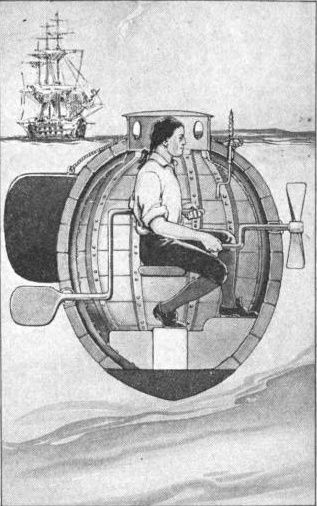
Washington took a keen interest, even taking a financial stake in the Turtle’s development. Writing to Thomas Jefferson in 1785, Washington recalled, “Bushnel [sic] is a man of great Mechanical powers- fertile of invention- and a master of execution” and that “I furnished him with money, and other aids...” And though the experiment was not successful in its attempted attack on the British fleet, Washington stated, “I then thought, and still think, that it was an effort of genius.” Whether or not he personally observed the Turtle’s sea trials in Old Lyme on that day is not known—but being in such immediate proximity he certainly would have been briefed on that critical effort by those who did.
That John McCurdy hosted Washington on the evening of April 10 doesn’t strain our sense of credulity. In fact it is much more likely than not. McCurdy was known as “The purse of the Revolution” and had been a staunch proponent of the patriotic cause since the days of the Stamp Act rebellion. His neighbor was the patriotic firebrand Reverend Stephen Johnson, author of the pamphlets opposing the Stamp Act, who also marched to Bunker Hill with Samuel Holden Parsons, a King’s Attorney turned rebel leader who would become Major General and right-hand man to Washington.
Parsons’ home was directly across the street from McCurdy’s, making this bend of the Post Road in Old Lyme an epicenter of the rebellion. While no physical battle was fought in Old Lyme, the war of ideas had long been waged and won there by these patriotic luminaries for well over a decade.
In terms of fanciful legends, there is one that persists from that fateful night of Washington's visit: the tale of Washington dancing the night away at the Peck Tavern’s upstairs ballroom. Famously known for his love of dance, and his skill at several steps, Washington would not let an early morning ruin the prospect of a late night quadrille or minuet.

At a gathering that evening in the tavern on the town’s North Green, it is said the General charmed the ladies with his moves, and in doing so, forever enshrined the Peck Tavern in our town’s mythos. Such a high-spirited frolic in the midst of war was not be out of character for Washington. General Nathanael Greene wrote of a night in March 1779 when Washington danced with his wife, Kitty: "His Excellency and Mrs. Greene danced upwards of three hours without once sitting down." General Henry Knox told a similar story of one night a month prior when Washington commandeered his wife Lucy as a dance partner.
While there is no written evidence affirming that Washington attended a shindig that night at the Peck Tavern—neither do we have proof he didn’t. Given his track record and proclivity, it’s more likely than not, and we have nothing to lose if we choose to believe that he did. A bit of heroic myth never hurt anyone, and dancing in the face of troubled times may serve as yet another good example set by our first president.


Comments